
The Internet's impact has touched us all in one way or another. While some internet activities are similar worldwide, there are many differences. (Todd, 2004, ¶4) The differences are for many reasons, age, sex, country, etc., and can influence and be influenced by social, economic, and political ideals. All types of media feed political knowledge and views: Television, Newspapers, Radio, Magazines, and Internet.
This section will discuss the influence of the Internet on the political activities. The impact and influence of the Internet is felt in many ways and on many levels, some of which include:
To view findings of the first World Internet Project and previous reports, visit www.ccp.ucla.edu. To see a Power Point slide show presentation of graphic representation of the results click here(no longer available). The following table is a partial collection of these results from UCLA's survey for World Internet Project showing the percentages for answers given by participants.
| / | / | Britian | China | Germany | Hungary | Italy | Japan | Korea | Singapore | Spain | Sweden | Taiwan | USA | ||||||||||||||||||||||||||
|---|---|---|---|---|---|---|---|---|---|---|---|---|---|---|---|---|---|---|---|---|---|---|---|---|---|---|---|---|---|---|---|---|---|---|---|---|---|---|---|
| % of Internet Users |
Total | 59.2 | - | 45.9 | 17.5 | 31.2 | 50.4 | 60.9 | 40.8 | 36.4 | 66.1 | 24.2 | 71.1 | ||||||||||||||||||||||||||
| % of the time Internet is accurate |
|
||||||||||||||||||||||||||||||||||||||
| Internet affected contact with people who share your political interests |
|
||||||||||||||||||||||||||||||||||||||
| Hours per week watching TV |
|
||||||||||||||||||||||||||||||||||||||
| Using the internet allows people to have more say about what the government does |
|
||||||||||||||||||||||||||||||||||||||
| Using the internet allows for better understanding of politics |
|
||||||||||||||||||||||||||||||||||||||
The interpretation of the findings seems to indicate that the Internet is becoming a major source of information worldwide. Unfortunately, like any findings these can be skewed by those "cyber-optimists" who believe that technology will increase each citizens political savvy making them more active and responsible and the "cyber-pessimists" who argue that the new technologies haven't made any difference. (Meinardus, 2003, ¶1)
One of the "cyber-optimists" the European Commissioner Erkki Liikanen, responsible for Enterprise and the Information Society (Liikanen, 2004, ¶1) gives a glowing account in his speech of how the Internet will bring government back to the people. While this is an admirable sentiment, it does not seem to be supported by the facts. The following is a quote from Commissioner Liikanen's speech given at the eDemocracy Seminar.
Information and communication technology and especially the Internet are a great tool to make governments more open and transparent. It empowers citizens. eGovernment can make governments more relevant to citizens by increasing participation and involvement in decision-making.
It can help restore ownership: the government is of the people. It also increases accountability. ICT makes it possible to follow all administrative steps in formulating and enacting law.
Prof. Manuel Castells said it this way: "the Internet can be used by citizens to watch their governments - rather than by governments to watch their citizens." (Liikanen, 2004, ¶2-4)
Despite Commissioner Erkki Liikanen and Prof. Manuel Castells' rosy out look for the future of the Internet as a way to gain political knowledge, as Ronald Meinardus of The Korea Times points out, "[there] is no guarantee that the information is actually made use of." (Meinardus, 2003, ¶3) In fact, according to Meinardus and backed up by the UCLA's World Internet Project, there seems to be little to no evidence supporting beliefs that the information available to help people to understand political issues is either being used or making much difference … yet.
The impact of the Internet in America was never so evident as it has been during the 2004 Presidential campaign. Mr. Dean's campaign used the Internet to sponsor and set up meetings of supporters, but most notable was his use of the Internet to raise campaign money. (Pew, 2004, ¶36)
The Pew Research Center for the People & the Press in under the direction of the Princeton Research Association use a telephone survey of people over 18 to from December 19, 2003 – January 4, 2004 asking such questions as the following:
Q.4  How have you been getting most of your news about the presidential election campaign?

     From television, from newspapers, from radio, from magazines, or from the Internet?

     [ACCEPT TWO ANSWERS: IF ONLY ONE RESPONSE IS GIVEN, PROBE FOR ONE ADDITIONAL RESPONSE]


                        June Feb  Jan    Sept April Feb    Sept Jun  May  March Feb

                        2000 2000 2000   1996 1996  1996   1992 1992 1992 1992  1992

     79  Television      65   73   75     75   81    85     83   84   86   83    80

     39  Newspapers      27   33   31     44   48    56     49   55   51   48    49

     15  Radio           11   15   12     14   21    21     13   18   17   14    18

     13  Internet         5    7    6      2    2     2     n/a  n/a  n/a  n/a   n/a

      2  Magazines        2    2    3      5    6     5      5    7    6    4     4

      2  Other            2    2    3      2    3     1      4    4    3    3     3

      2  Don't know/Ref.  2    1    1      1    1     1      1    *    1    *     1
To view the questionnaire visit "Early January 2004 Political Communications Study" for a complete list of questions and the results to those questions. To view the full report in Adobe Acrobat format (.pdf) click here.
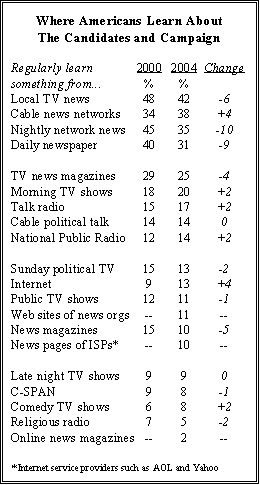
Americans are gradually changing how we choose to get the latest news, and election news is no different. Where we go to get election and campaign news is slowly changing, as we become a more global society. According to the Pew Research Center's survey (see Figure 1) local TV news, despite a -6% change, is still the major source of information about candidates and their campaigns. Of the twenty sources covered in the survey, eleven dropped, three additions since 2000 that have no comparison, but only six have risen since the 2000 presidential campaign. The top two are cable news networks and the Internet. (Pew, 2004)
Where the Internet has made the biggest impact is the under 30 crowd. Young people are traditionally the hardest to target when trying to get information to them, and in a medium they will use. The Pew survey shows that traditional media took a large downturn in the 18-29 age group. This downwards trend is very apparent in the area of the nightly network news media, the percentage of young people who get election information from this source went from 39% in 2000 to 23% in 2004. (Pew, 2004, ¶5) Election information for this age group comes mostly from comedy shows and the Internet. (Pew, 2004, ¶6) While this comes as no surprise, what does is that where you get your campaign information does. Where you get your information can make a big difference in what you know about the election, the campaigns, and the candidates. Studies show that those who get their information from the Internet, National Public Radio, and news magazines are the best informed about the election campaigns. So while the internet may not yet be the main source of election news in America it is proving to be a very strong contender.
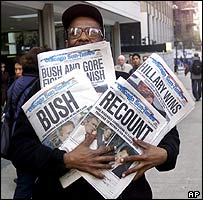
The local level can be as important as the country when, as with the last election, you come down to a tight vote. Florida, during the 2000 election was the vote that galvanized a nation. Not only was it a tight vote, but voting irregularities, seniors belittled as unable to understand what turned out to be a flawed voting system, and the electoral college system coming under scrutiny held us in thrall as not only America, but the world watched.
While not as dramatic as the Florida 2000 presidential election, Maryland has, nonetheless, come under scrutiny for their new computerized voting machines. The machines, thought to be the answer to problems such as came to light in Florida, proved to have their own problems. After a review of the machines and their software 328 security weaknesses came to light. (Schulte, 2003, ¶1) It was later revealed that the software systems alone where looked into and not how the entire system would be used. Therefore, while this was not as bad as portrayed, it did seem to feed the fuel of those who believe an online voting system would be too insecure a system.
Maryland seems to have it all covered all the bases, from the sublime (easy to understand and use computerized voting system) to the ridiculous. Taking his protest action online, Bryan Ward of Ellicott, Maryland, decided to sell his vote on eBay. In his protest against political corruption, Mr. Ward may have over looked a few laws, but needless to say, he did get people's attention. With bids rising from the $5 minimum to $10,100 within 20 bids, Mr. Ward may have been correct in his statement that "Democracy [is] for sale!" (Stenger, 2000)
Many candidates, on all levels of government, have web pages that contain biographies, position on issues, press releases, campaign notes, regular updates, and blots. So while there is access to information in newspapers, news magazines and television, there is also a wealth of information online. Internet users tend to be better informed voters and that can only help us all.